
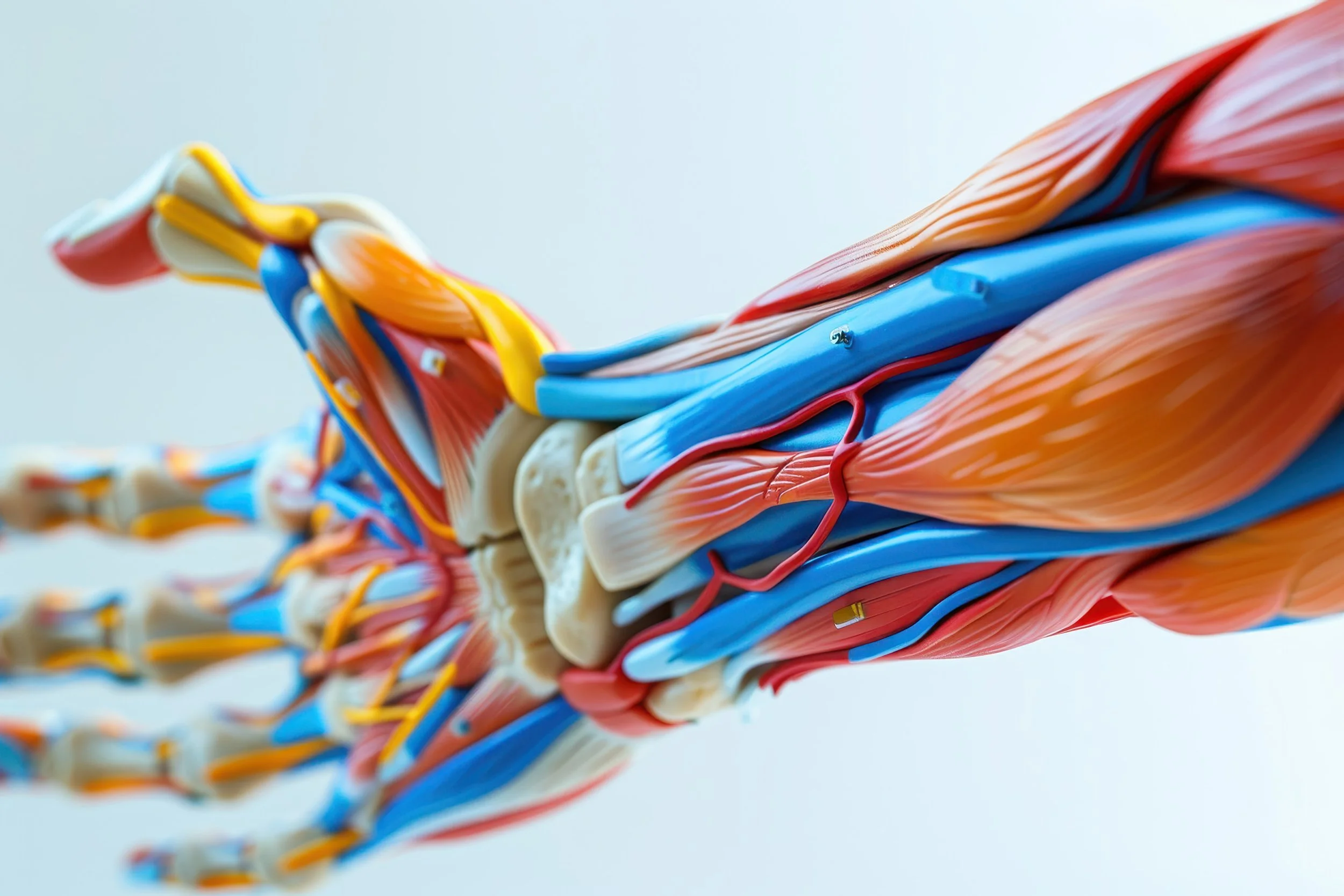
Osteopathy for Wrist and Hand Pain & Injury in Victoria, BC
Hand and wrist pain are often the result of how the entire upper body is aligning, moving, and distributing load through the arm. Osteopathy is a form of manual therapy. I trace the root causes of pain and dysfunction to skeletal restrictions and displacements and realign the body. In the wrist and hand, symptoms may be influenced by restrictions or misalignment patterns such as limited wrist joint motion, irritation or compression of the small hand and wrist bones, forearm rotation imbalance, elbow restriction, or shoulder and ribcage dysfunction that alters how force travels down the arm. When these structures are misaligned causing restriction, the body adapts by creating unequal distributions of muscle tension (muscle imbalances) and joint compression, which can irritate tissues, limit mobility, and increase strain through surrounding regions. In many cases, pain is not only coming from the wrist or hand itself, but from restrictions elsewhere that force the area to compensate, such as elbow stiffness affecting forearm mechanics, shoulder restriction increasing strain through the wrist, or nerve sensitivity originating from the neck. Treatment begins with an assessment of alignment and motion through the full body, then I use hands-on techniques to calm irritated tissues, decompress restricted joints, release muscular and fascial tension, and correct skeletal alignment to relieve pain and support healthier movement patterns throughout the hand, wrist, and entire body.
Common Causes of Hand and Wrist Pain That I Treat
> Wrist sprains and post-injury stiffness
> Overuse injuries from typing, gripping, lifting, or repetitive work
> Tendon irritation such as extensor or flexor tendon overload
> De Quervain type thumb and wrist pain patterns
> Carpal tunnel style symptoms and nerve compression patterns
> Forearm muscle strain and chronic tightness
> Joint restriction in the wrist or hand bones
> Elbow restriction affecting forearm rotation and wrist function
> Shoulder or upper back dysfunction increasing strain down the arm
> Postural overload and compensation patterns through the neck and ribcage
Symptoms That Often Accompany Wrist and Hand Dysfunction
> Pain with gripping, lifting, or weight bearing through the hand
> Stiffness and reduced wrist range of motion
> Weakness or loss of endurance in the hand and forearm
> Tingling or numbness in the fingers
> Burning, aching, or sharp pain that comes and goes
> Swelling, tightness, or a “pressure” feeling
> Pain that radiates into the forearm or up toward the elbow
> Thumb pain with pinching or texting type motions
> Reduced coordination or a sense of clumsiness
What to Expect in Treatment
Hand and wrist issues can present in many ways, from sharp pain after a fall or sudden strain, to long-term repetitive overuse from typing, gripping, lifting, or sport. Because the hand is highly sensitive and structurally complex, the body often responds with protective tension, inflammation, and reduced movement through the wrist and forearm. Treatment is gentle and specific, and always adjusted to your comfort level. Osteopathic care may involve restoring motion through the wrist and forearm bones, relieving restriction through the elbow, shoulder, and ribcage, reducing muscular and fascial tension through the arm, and improving how the nervous system and circulation interact with the tissues. The goal is to restore comfort, mobility, and strength while reducing compensation patterns that can cause the issue to recur.
Treatment begins with assessing movement and alignment through the entire chain, including the hand and wrist bones, forearm rotation, elbow mechanics, shoulder mobility, and the neck and ribcage when needed. Many wrist and hand problems persist because the tissues are overloaded by compensation patterns coming from above, or because the nervous system remains sensitized after injury. Treatment is gentle and specific, designed to calm irritation, reduce compression, and restore efficient biomechanics. Hands on techniques may include joint decompression, soft tissue and fascial release through the forearm and hand, mobilization of wrist and carpal bones, and correcting restrictions through the elbow, shoulder, ribs, or cervical spine. The goal is to relieve pain while improving mobility, strength, and resilience for daily tasks and activity.
Wrist and hand Treatment FAQ
How many treatments will I need?
This depends on whether the issue is acute or long-standing, how restricted the wrist and forearm are, and whether nerve irritation is involved. Many people notice improvement within 1 to 3 sessions, while chronic repetitive strain patterns may require a series of treatments.
Is treatment gentle if my wrist is very sore?
Yes. Treatment is always adapted to your comfort level. The goal is to reduce irritation and restore movement without aggravating inflamed tissues.
Can osteopathy help carpal tunnel symptoms?
Often yes, depending on the cause. Symptoms such as numbness, tingling, and hand weakness can be related to nerve irritation or mechanical compression along the wrist, forearm, elbow, shoulder, or neck. We assesses the full pathway.
Can osteopathy help after a wrist sprain or fracture?
Yes, especially for restoring mobility, alignment, and normal movement once the injury has healed and it is safe to begin manual treatment. Post injury stiffness and compensation patterns are very common.
-
Head Injuries
Concussion Recovery
Post-Concussion Syndrome (PCS)
Headaches
Migraines
Whiplash
Neck Injuries
Deviated Septum
Jaw TMJ Dysfunction
Shoulder Injuries
Back Injuries
Scoliosis
Sciatica
Piriformis Syndrome
S.I. Joint Dysfunction
Pelvic Alignment
Hand, Wrist, and Elbow Injuries
Digestive Issues
Shallow Breathing
Anxiety
Hip, Knee, Ankle, and Foot Injuries
Post-pregnancy
Infantile Colic
Kids (all ages)
Complex & Unresolved Cases
Nerve Irritation / Tingling
Nervous System Regulation
Optimizing Biomechanics + Athletic Performance
And More
-
Our sessions are usually 60+ minutes, depending on how your body responds. I like to focus on what can be achieved in each session rather than adhering to set amounts of time. Some treatments take longer to address deeper issues, while others are more straightforward.
-
The spacing of our sessions is guided by progression and regression. Early in treatment, especially with complex cases, the optimal approach is to keep our session spacing close together. This minimizes the window for regression which allows us to make continuous progress without having to redo work done from previous visits.
As your body responds and primary adjustments are achieved, our treatment frequency tapers, for example: weekly sessions become biweekly → monthly → every 2–3 months → 3–6 months → yearly, until optimal recovery is complete.
-
Easy Cases: 1 - 8 sessions
Moderate: 8 - 16 sessions
Complex: 16 - 20+ sessions
-
Condensed treatment strategies are used for international cases and those travelling from long distances. 3 - 6 weeks is the general timeframe for condensed treatment plans.
-
Perceived Percentage of Recovery (PPR): A simple metric used to gauge overall recovery progress. 0% represents the worst state imaginable and 100% represents a return to full function with no symptoms. We use this metric as a communication tool for quick assessment and feedback.
Symptom Tracking Journal: An in-depth tracking system used to gauge individual symptom progress. We quickly adapt to our new normal, so it can be difficult to remember how we felt last week, last month, or even yesterday. This tracking system helps us become aware of individual symptom changes as they occur.
-
$180 - 30+ minutes
$360 - 60+ minutes
These rates reflect the level of skill and individualized focus each patient receives.
-
Acupuncture and Massage Therapy pair well with Osteopathy. See the Health Resources page for trusted referrals.
-
Osteopathic treatment is covered through most private insurance and group benefit plans. For those who have coverage, a portion of your treatment expenses are reimbursed upon submitting your receipts.
-
I sterilize all equipment with alcohol before and after each use. Breathing freely and fully is a vital aspect of treatment, therefore, masks are not allowed. In order to ensure optimal results from treatment, there are several protocols that I ask each patient to adopt. These protocols are listed through the patient portal which you will have access to upon acceptance of your case.